In October 2023, the International Olympic Committee (IOC) announced that flag football will be one of five new sports (along with T20 cricket, baseball/softball, lacrosse and squash) to be introduced to the 2028 Summer Olympic and Paralympic Games in Los Angeles (LA Olympics). The announcement was made at an IOC meeting in Mumbai, following a proposal from the LA Olympics’ officials and a recommendation from the IOC Executive Board.
What Is Flag Football?
Flag football is a variant of American football. The major difference is, instead of the crunching tackles or sacks you’ll see on a National Football League (NFL) field, the sport is noncontact. Tackles are made by pulling off an opponent’s flag, which all players have to wear round their waist.
In February 2023, as discussed in a previous blog article, an amateur rugby player was held liable by the English civil courts for injuring an opposition player “without any regard for [their] wellbeing or safety… and intent only on exactly revenge”.[1] Given the nature of the offending ‘tackle’ (which rendered the claimant paraplegic and was described by the judge as “deliberate”, “gratuitous” and “obviously dangerous”), it begs the question of when conduct on the field of play could (or should) constitute a criminal act and be prosecuted accordingly?
There have been various instances over the last 3-4 years where on-field actions have prompted allegations of criminality. For instance, during the 2019 Rugby World Cup in Japan, former Welsh international Jamie Roberts suggested that Sebastien Vahaamahina’s red card (for elbowing Aaron Wainwright in the face during a maul) in the France vs Wales quarter-final “belonged in a criminal court, let alone in front of a rugby judiciary”. Meanwhile, a sickening crash in the 2020 Tour de Pologne prompted the General Manager of Dutch Deceunick-Quick-Step (“DQS”) to publicly state that Dylan Groenewegen should be “thrown in jail” for deviating into Fabio Jakobsen’s line, causing him to collide with external barriers[2], and leaving the DQS rider with life-threatening injuries.[3]
It is worth noting that neither of the above resulted in criminal prosecutions and, where incidents occur outside the UK (such as those), they would be handled under local law in any event. That said, there is a bar – albeit a high one in England and Wales – whereby law enforcement will be obliged to intervene in relation to acts committed on the sports field. In this article, Henry Goldschmidt examines the uneasy relationship between sport and criminality under English law and how internal disciplinary, civil and criminal proceedings can overlap in respect of on-field violence.
Women’s football is firmly in the spotlight this summer. Following a record-breaking domestic season, where viewership and live audiences for the Women’s Super League (WSL) hit an all time high, the expanded World Cup format is showcasing the ever-increasing quality and strength in depth of the women’s game. Despite a faltering build up for the Lionesses, not least with knee injuries ruling the captain, Leah Williamson, and star players Beth Mead and Fran Kirby out of the tournament, the European champions are showing good promise on the pitch after progressing to the knock-out stages with an emphatic win against China.
While all signs point towards a bright future for women’s football in England and beyond, the sport is still at a nascent stage. There remain clear opportunities for improvement and growth.
The 2023 NCAA Division I Women’s Basketball national championship averaged 9.9 million viewers, becoming the most-watched women’s college basketball game and ESPN platforms’ most-viewed college basketball game (men’s or women’s) on record, and it was not even playing in a prime-time slot. This shows a tidal shift in the interest and growing opportunity in women’s sports, and portends ensuing attention on the governing bodies who oversee them.
How we got here
Women’s sports have historically not been treated equally compared to their male counterparts, and the findings have been well documented. For one prominent example, the USA Women’s National Soccer Team filed a discrimination lawsuit against the U.S. Soccer Federation for paying their male counterparts more than them on the basis that the men’s game “requires a higher level of skill.” …
On 21 February 2023, the World Anti-Doping Agency (“WADA”) issued a statement confirming that it was appealing the decision of the disciplinary tribunal of the Russian Anti-Doping Agency (“RUSADA”) in the case of Kamila Valieva to the Court of Arbitration for Sport (“CAS”). Although the full decision has not been published, the RUSADA tribunal found that the teenage figure skater bore ‘no fault or negligence’ (“NFON”) in testing positive for a banned heart drug, Trimetazidine, in December 2021 and, as such, no period of ineligibility was imposed.
Based on information in the public domain relating to the sample in question, and the explanation reportedly provided on behalf of Valieva (discussed below), WADA’s decision to appeal is unsurprising. Indeed, pleading NFON is notoriously difficult under the WADA regime and, whilst WADA does not provide specific data of the incidence of inadvertent doping, statistics for 2017 showed that only 4% of positive tests resulted in no sanction at all.[1] As well as looking at the background of the Valieva case, I examine below:
the requisite legal hurdles that an athlete must overcome to establish NFON;
the types of cases where the threshold has been deemed to be met;
why ‘no significant fault or negligence’ (“NSFON”) awards are more commonplace for inadvertent anti-doping rule violations (“ADRVs”); and
what other factors might enable an athlete to eliminate their sanction.
This article was written for and first published by LawInSport. The original version is available to view here
The UAE government has always placed a strong emphasis on physical education for Emirati and expat youth and as early as 2010, the government started introducing binding regulations 1in that space. In time, this also started trickling down to numerous school sports programs and initiatives that are aimed at healthy living. Practicing organized sports has proven benefits in reducing the risk of child-obesity and combating historically high rates of Type 2 Diabetes not to mention mental health and well-being benefits, by promoting socialization, self-esteem and self-confidence.
The sports industry and parents are no doubt glad to see that the UAE is not resting on its laurels and is seeking to do more by legislating for further development and maturity. The 2021-2022 UAE legislative agenda was the busiest in some years, with progressive and wide-ranging new legislation that includes promising developments for sports. This momentum shows little signs of slowing down, including in the sports sector.
This article examines the latest developments in grassroots sport in the UAE, looking at:
Scouting local talent
New sports law
New synergies (and oversight)?
The role of organized youth sports in the development of professional sports and national sports teams
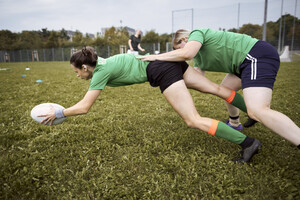
On 23 February 2023, the English High Court ruled that amateur rugby player Natasha King had been negligent when she executed a “tackle” on opponent Dani Czernuszka “without any regard for the well-being or safety of the [latter] and intent only on exacting revenge” during a women’s developmental match.[1] As such, Ms King (the Defendant) was deemed liable for the life-changing injuries that Ms Czernuszka (the Claimant) sustained in October 2017 – a T11/12 fracture, resulting in paraplegia. Liability and quantum were bifurcated so there will now be an assessment of the applicable damages, which could be considerable.
Aside from the impact on the parties involved, this case raises legal issues regarding expert evidence, the relevant standard of care owed between sportspersons, premeditation, and distinguishing between a dangerous act and one that is legally negligent (a distinction that counsel for the Claimant asserted is “paper thin”[2]). There is also a wider question: should this finding of on-field negligence be a cause of concern (or, conversely, provide some comfort) for sports participants in England and Wales?
The Advertising Standards Authority (“ASA”) has issued its first ruling under the new rules that prohibit gambling ads with “strong appeal” to under-18s, providing a useful example as to how the new rules will be applied.
Updated Gambling Ad Rules
As covered in more detail in a previous article for this blog, on 1 October 2022 new rules in the UK advertising codes came into effect that restrict the content of gambling ads. The rules of both the UK Code of Non-Broadcast Advertising and Direct & Promotional Marketing (“CAP Code”) and the UK Code of Broadcast Advertising (“BCAP Code”) were updated to prohibit all gambling ads that are “likely to be of strong appeal to children or young persons, especially by reflecting or being associated with youth culture”.
This article was written for and first published by LawInSport. The original version is available to view here
During Australia’s 2022 National Rugby League season, seven players from the Manly Sea Eagles, a team in the National Rugby League competition, refused to play in a jersey that featured rainbow trim. The design, called the “Everyone in League” kit, was intended to be worn by the team as a one-off to celebrate inclusivity, but it became known as a “pride jersey”, supporting the LGBTIQ+ community, due to the use of the rainbow palette. The seven players cited religious and cultural objections to wearing the jersey and, because the rules of the National Rugby League require all players in a team to wear a “distinctive” (seemingly interpreted as “identical”) jersey1, opted not to play the match in which the jersey was worn.
The story made international headlines2 and was widely talked about across Australia. Instead of uniting the rugby league community to promote inclusivity, the issue divided the Manly Sea Eagles team, rugby league fans and the general population. While some argued that a sporting club has no right to force a particular ideology on its players, others argued that wearing the jersey was just part of their “job”.
The “pride jersey” controversy highlights an important message for all organisations that want to foster diversity, equity and inclusion (DEI) – even initiatives implemented with the best of intentions can have unintended consequences. With that in mind, and taking inspiration from other events in the world of sport, this article examines some interesting examples from Australia and the UAE, before suggesting some “rules of play” for organisations to follow to lessen the risk of inadvertent outcomes.
Now that a regulatory framework is in place, either by way of the NCAA’s interim policy or through the various state laws discussed in the second iteration of this blog series, academic institutions and private entities, such as alumni and companies, have quickly engaged in the NIL space. This final post of our three-part blog series explores some of the ways these entities and individuals have interacted with NIL in the world of college athletics.
How Schools and Their Athletes Are Entering the Mix
Recognizing that NIL deals are now a significant factor in recruitment and that NIL is here to stay, schools are getting involved in the process. This is primarily accomplished in two ways: through school-specific NIL policies, and NIL departments aimed at facilitating and educating players.